
Column Packing


MilliporeSigma™ Supelco™ Florisil™ PR Grade (analysis acc. to FDA)
Florisil™ was used: as column packing material in column chromatography. as an adsorbent in gas chromatography with electron capture detector (GC/ECD), capillary column chromatography, adsorption column chromatography. in clean-up procedures in gas chromatography-tandem mass spectrometry and GC-FID

MilliporeSigma™ LiChrosorb™ RP-8 Sorbents, 10μm
well suited for the separation of neutral, acidic and weak basic compounds.

MilliporeSigma™ LiChrospher™ Si 60 (5μm) Silica Gel
Used for normal phase chromatography. MilliporeSigma™ LiChrospher™ Si 60 (5μm) Silica Gel is a versatile HPLC spherical silica sorbent with a pore diameter of 60 Angstrom and a particle size of 5μm.
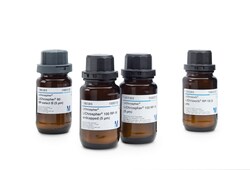
MilliporeSigma™ LiChrospher™ 100 RP-8 Sorbents
well suited for the separation of neutral, acidic and weak basic compounds.

MilliporeSigma™ LiChrosorb™ RP-18 Sorbents, 5μm
well suited for the separation of neutral, acidic and weak basic compounds.

Silica 36-200μm, 60Å, EcoChrom™, MP Biomedicals™
For Chromatography; Chemical Synthesis

Cytiva HiLoad™ 16/600 Superdex™ 30 pg Prepacked Column
Designed for high-resolution preparative gel filtration chromatography separating peptides

Supel™ QuE Z-Sep Bulk, Sold by MilliporeSigma™ Supelco™
Enhances sample cleanup for complex matrices. Effectively removes more fat and color from sample extracts than traditional phases for QuEChERS LC-MS methods.
Silica Gel, Grade 60, 60-200 Micron, 60A, Spectrum™ Chemical
MilliporeSigma™ LiChrospher™ 60 RP-Select B Sorbents
Sperical particles of silica with with octyl derivative

Alumina N, 7-12μM, MP Biomedicals™
Alumina is used as an adsorbent, desiccating agent, and catalyst, and in the manufacture of dental cements and refractories
Alumina B, 32-63μM, Active, MP Biomedicals™
For Use in Column Chromatography and Adsorptive Filtration
MilliporeSigma™ LiChrospher™ 100 RP-8 Endcapped Sorbents
well suited for the separation of neutral, acidic and weak basic compounds.

Silica gel 60 PF254 for preparative thin layer chromatography, MilliporeSigma™
Silica gel 60 PF254 for preparative thin layer chromatography. CAS No. 7631-86-9, EC Number 231-545-4.
Silica gel 60 PF254 + 366 for preparative layer chromatography, MilliporeSigma™
Silica gel 60 PF254+366 for preparative layer chromatography. CAS No. 7631-86-9, EC Number 231-545-4.